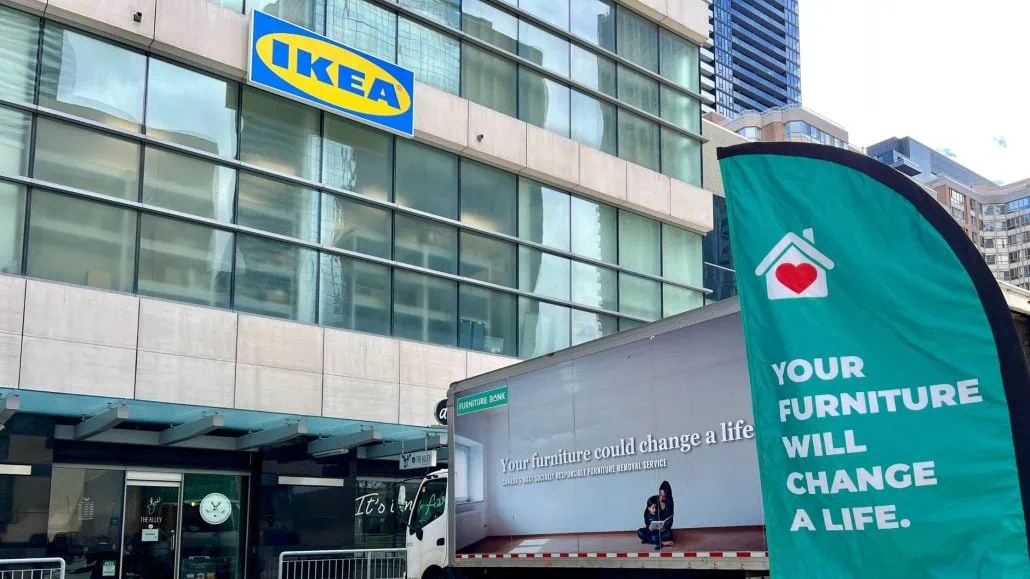
IKEA's Landmark Commitment in 2024
IKEA Canada has announced a landmark $300,000 investment to expand its partnership with Furniture Bank nationwide. This latest commitment reinforces their multi-million-dollar collaboration in the Greater Toronto Area (GTA), now set to broaden in scope across Canada. The funds will enable Furniture Bank to onboard additional charities and social enterprises in Ottawa, Montreal, Halifax, and Winnipeg, allowing them to further address furniture poverty while promoting sustainability. IKEA’s investment not only amplifies the social impact but also sets industry standards for corporate responsibility and environmental stewardship.
Furniture Bank and IKEA's circularity drive
Quick Read
Furniture banks in Canada, the USA, and the UK have been leading the charge in circularity for over three decades, focusing on social impact through the reuse of furniture. Despite their significant contributions, these efforts have remained under the radar in broader discussions on circular economy and ESG (Environmental, Social, and Governance) innovation.
Why it matters: This partnership with IKEA Canada exemplifies how corporate and nonprofit sectors can collaborate to drive both environmental sustainability and social impact, setting a precedent for the industry in corporate responsibility and environmental stewardship.
IKEA’s landmark investment: IKEA Canada’s recent $300,000 investment in Furniture Bank aims to extend their collaboration nationwide, enhancing the reach of their sustainability efforts and addressing furniture poverty across more communities.
Pilot program success: The partnership began with a focus on repurposing returned mattresses, a move that has since expanded to include all IKEA locations in the Greater Toronto Area, demonstrating the potential for scalable circular economy solutions.
The bottom line: IKEA Canada and Furniture Bank’s collaboration serves as a beacon for integrating environmental and social objectives into business models, showcasing the tangible benefits of circular economy principles in action.
The Origin of IKEA and Furniture Bank Pilot
The collaboration between IKEA Canada and Furniture Bank initially emerged in 2019 from a mutual interest in sustainability and social impact. This partnership was sparked by a meeting between Melissa from IKEA and Annalee from Furniture Link at Toronto’s Circular Economy Working Group. During this gathering, they recognized a shared objective: repurpose returned mattresses to address both IKEA’s disposal challenges and Furniture Bank’s need for quality mattresses.
With this alignment, a pilot program was launched in 2020. Initially involving four IKEA stores within the Greater Toronto Area (GTA), this effort focused on efficiently managing returned mattresses. IKEA would bag and store these returns, and Furniture Bank would assess and redistribute them, ensuring careful selection based on usability. By implementing a scalable reverse logistics solution, the partnership not only reduced waste but also extended the lifecycle of these products, underscoring the efficacy of circular economy principles.
The success of this pilot prompted a formal partnership expansion, allowing the initiative to include all 6 GTA locations. This demonstrated how corporate and nonprofit entities could collaboratively drive environmental and social impact, laying the groundwork for broader national efforts and exemplifying a sustainable model for resource reutilization.
The Business Case for Circularity and Social Impact
The IKEA Canada-Furniture Bank partnership serves as a model for integrating environmental and social goals into business operations:
-
Optimized Resource Use: The collaboration effectively repurposes returned and end-of-life furniture, reducing waste and demand for new resources.
-
Economic Value Creation: By reusing items such as the 25,000 mattresses donated since 2019, economic value is created, approximating an in-kind value of $4 million.
-
Enhanced ESG Performance: This measurable social and environmental impact strengthens IKEA's sustainability reporting and reinforces its leadership in ESG innovation.
Circular Economy in Action through REUSE

This partnership operationalizes circular economy principles:
-
Mattress Reuse Program: The sustainable model for mattress reuse has provided essential furnishings to 11,680 individuals and families and prevented 1,734 metric tons of CO2 emissions, aligning with IKEA’s environmental goals.
-
Kitchen Cabinet Repurposing: In Toronto, end-of-life kitchen cabinets were transformed into over 1,000 kitchens for housing projects, expanding the application of circular principles beyond just furniture.
-
National Expansion: IKEA’s $300,000 investment facilitates Furniture Bank's expansion into new cities, addressing furniture poverty in more communities.
Economic and Social ROI: A Partnership of Impact
Corporations evaluating their sustainability partnerships can learn from the economic and social ROI of the IKEA-Furniture Bank collaboration:
-
Cost Savings and Carbon Reduction: Diverting furniture from landfills curtails disposal costs and delivers CO2 savings, akin to removing over 7 million kilometers of car travel annually.
-
Community Value: Supplying essential furnishings to marginalized populations promotes social stability, enhancing both IKEA’s reputation and community well-being.
Aligning with ESG & Sustainability Goals
IKEA’s role in this partnership underlines its dedication to its own robust Sustainability strategy: PEOPLE & PLANET 2030
-
Environmental Sustainability: Waste diversion directly supports IKEA’s circular economy objectives.
-
Social Equity: Furniture Bank’s focus on aiding low-income families and marginalized communities enhances IKEA's social justice contributions, while funding the mission of Furniture Bank to ensuring families have furnished homes
-
Governance Excellence: Transparent reporting builds trust among stakeholders, positioning IKEA as a leader in sustainable business and Furniture Bank as social enterprise supplier with IWAY Certification!
Scaling circularity and ESG success
As IKEA and Furniture Bank expand their proven partnership nationally, the opportunity for corporate engagement in the circular economy is evident. This collaboration illustrates how businesses can achieve dual economic and social impact by aligning with organizations that prioritize re-use and sustainability.
Why it matters: Furniture banks stand as “Outposts of Circularity,” offering businesses an unmatched chance to reduce waste and enhance community welfare. For companies aiming to excel in sustainability, partnerships like this present pathways for profound change—turning waste into value and ensuring that every family can access a dignified home. Investing in Furniture Bank programs is an investment in social equity and a strategic move towards environmental responsibility. Together, we envision a future where sustainability and social good are integral to every business strategy.
Learn More
Furniture Bank Articles & Case Studies
- IKEA In The Community | Furniture Bank
- IKEA | Furniture Bank
- IKEA Volunteers Make A Positive Impact: Building 3 Bedrooms For Children In Need | Furniture Bank
- The Gift Of Ikea Grusblad | Furniture Bank
IKEA News Releases & Social Support
 Furniture Bank
 FURNITURE BANK